
Navigating modern complexity through legal protection and mindful orientation.
Licensed in California (2007) and New York (2011), Jesse Lee Weiss is a business and entertainment attorney specializing in Business Development, Asset Purchases, Intellectual Property, Tech and Media, including Music, Film, and TV.
She has held Managing Attorney and Senior Attorney roles at firms representing globally recognized and award-winning clients, overseeing multifaceted global estates and complex matters.
The JLW Legal Approach.
Jesse leads negotiations and complex deal structuring, guiding clients through both strategic growth initiatives and sensitive disputes.
Her firm emphasizes business development and strategic negotiation, drawing on a background in alternative dispute resolution to identify creative avenues and durable paths forward.
Precision Writing. Strategic Negotiation.
A core focus of the firm is business protection through
disciplined writing and structured negotiation.
Every matter begins with listening – identifying what matters, what is legally relevant,
and what outcome the client ultimately wants to pursue.
Understand the full landscape – what has happened,
what is happening, and what success looks like.
Extract and organize the legally relevant facts.
Calibrate tone and strategy based on risk tolerance and long-term objectives.
Written communication is firm and measured.
Even when strong, it leaves space for dialogue – creating leverage without unnecessary escalation.
Options are outlined clearly – implications, costs, timing, and strategic tradeoffs.
Clients decide with the broader picture in mind.
The process continues until the matter is resolved efficiently and with strength.

Each pillar links to its Substack Article Overview.
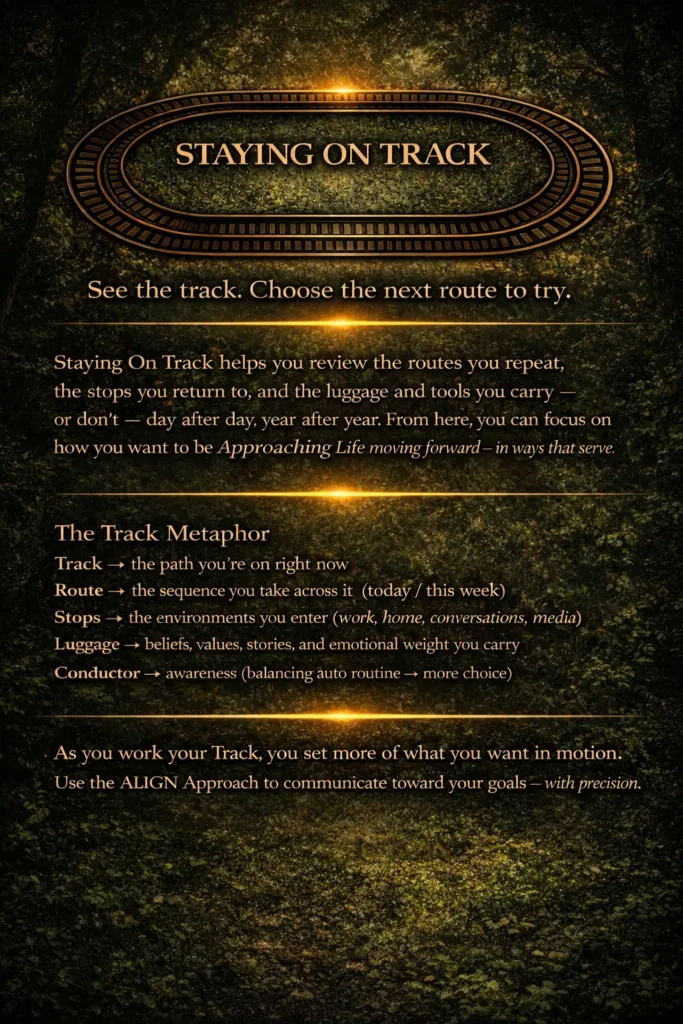
Orientation of Thoughts: A field guide for observing the track you’re on and refining routes that serve. It solves the problem of losing track of where you are going.
Ideas & Action Plans: Moving from instinctual, reactive communication to intentional response. Slow The Moment to Shape The Direction.
Building Capacity: How to think, speak, and disagree in ways that build capacity—not heat. Focuses on Themes: Enough, Breadth & Depth, Offense & Defense, and Closer to Human.
Approaching Life is a complete system made up of three connected – but independently useful – frameworks, with paradigms throughout.
You can enter through any one of them, depending on what you’re facing.
Each pillar speaks to different moments of need – defining the big picture, moving intentionally through the details, and thinking about how we and others think so that we engage constructively with others, and within ourselves, as we manage toward goals.
The logic applied to complex legal negotiations is the same logic applied to a train of thought – identify the moving parts, extract what matters, and decide which path to try next.
Taking the time to think before responding
can alter the direction of a conversation or action.
We examine the options on the table, how each could play out,
and how they align with the broader picture.
Disagreement does not require agreement or disconnection but the strongest communicators will still find enough understanding.
With structure and steadiness, we can stay in conversations across difference and build understanding without collapsing into heat.
Behind every argument, policy, and position are people.
The work is to remain steady enough to see complexity clearly
and respond in ways that move us closer to thoughtful engagement.
Rather than moving further apart and being divided,
the strongest leaders and thinkers of ideas
Unite Us.
After all, we are
Closer To Human
than any race, religion, culture, or lifestyle.
The work is to remain steady enough to stay open and curious –
choosing language that connects – via emotional and social intelligences.
What problem it solves.
Life is full, active, and layered. It’s easy to lose track of where you’ve been, where you are, but more importantly where you’re going.
Why be off your track often when you can take time to define your current Track – so that you more easily know when you’re off and can more readily get back on.
This can be a simple track like working on calm, listening better, feeling honored to be at work – even if you are working towards a new job or different career in the long run. How we are today effects and creates preparedness to meet opportunities for when we are ready to try new routes.
So you Slow The Moment to review and observe that tracks and routes you’re currently on – where you’ve been and where you are (orientation), so that you can Shape The Direction.
When people reach for it.
In that quiet moment of knowing you’re busy but want more direction, momentum, and alignment with a life that serves. When life feels repetitive, heavy, slightly off, or when you’re ready to level up, and want to understand where you actually are before deciding what action to take next.
What changes when you use it.
You build out your perspective – in Breadth and Depth. You switch from the old track you’ve been on that no longer serves over to the Track you’re now going to stay focused on and come back to if/when you slide off – either by accident or on purpose when trying new routes.
A field guide for observing the track you’re on – and refining routes that serve.
What problem it solves.
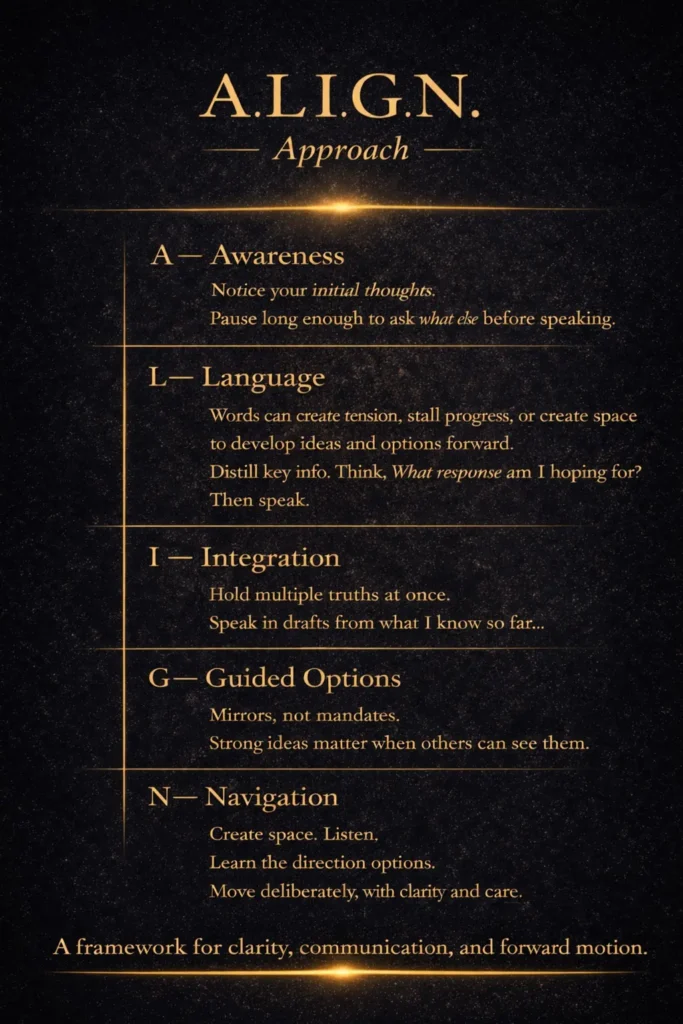
Instinctual, immediate reactive communications and actions – where often even a few minutes+ of time to think on how you want to respond, can meaningfully and immensely impact the direction a conversation or action have.
Slow The Moment to Shape The Direction – so ideas, language, and action plans serve the goals.
When people reach for it.
In moments of leadership, negotiation, conflict, or decision-making – when how you move matters as much as what you decide.
What changes when you use it.
You move from reaction to educated, well thought out intention – a real game plan.
Awareness steadies you, language shapes the field, multiple truths can coexist.
You see a broader and/or deeper landscape of options for paths forward, and action and navigation thereafter become more deliberate, adaptive, and aligned with both your goals and the bigger picture – often including the same for those around you.
A framework for navigating Communication, Conflict, and Connection with Clarity and Calm.
What problem it solves.
Destructive, nonproductive discourse, lacking in decorum and order. Winning arguments at the cost of understanding, relationships, and paths forward.
Moving discourse from heat to insight – so disagreement preserves decorum, understanding, relationships, and paths forward.
Creating space for insight, understanding, Breadth and Depth, and growth – so disagreement strengthens and elevates conversation.
When people reach for it.
When engaging ideas, disagreements, or complex topics – especially in public, professional, or high-stakes environments.
What changes when you use it.
Disagreement becomes productive. Thinking sharpens, and conversations elevate into more rigorous thinking about thinking, policy, and how to move forward – based on the intricacies of a given moment.
Curiosity and openness remain intact. Listening improves. People finish thoughts. When people feel heard, they become better listeners in return – when it’s the speaker’s turn to become the listener. Conversations build out and around capacity.
A way to think, speak, disagree, and make decisions that builds capacity through conversation development.
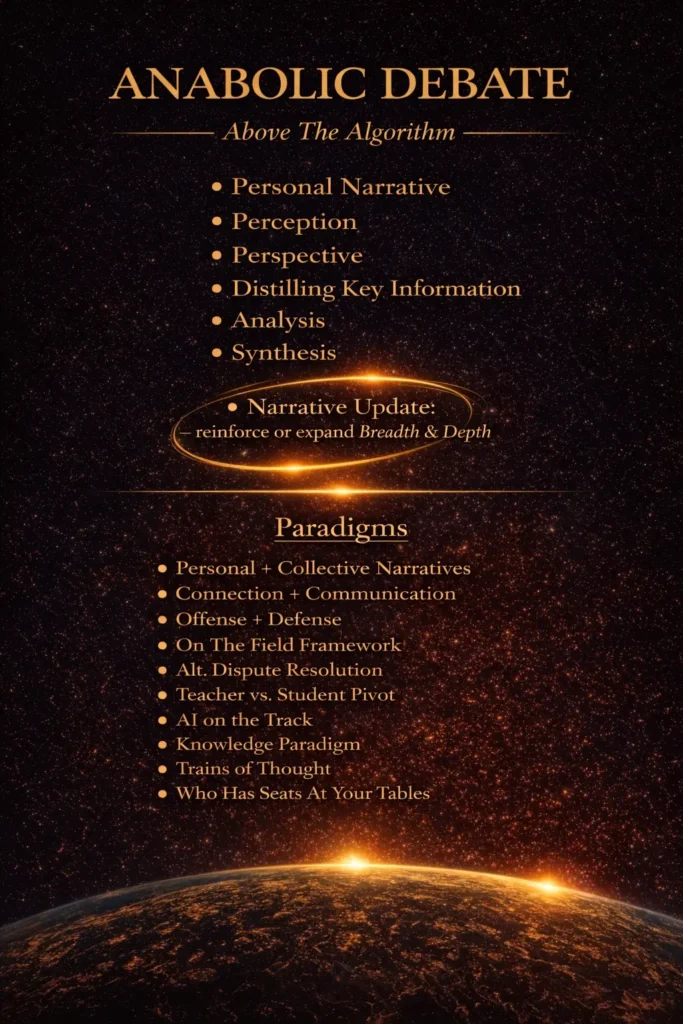
As you better see your Track, you can better work with it. We work to accept, process, and move on—learning new skills as we roll on.